Custom Software vs Off the Shelf Software for Wholesale Business in Pakistan
A real comparison of custom software and off the shelf tools for wholesale and distribution businesses in Pakistan, covering cost, FBR rules, and when each option actually works.
Custom Software vs Off the Shelf Software for Wholesale Business in Pakistan
Quick Answer
If your wholesale business runs on simple, standard workflows, off the shelf software will probably do the job and get you started within days at low cost. Once your business runs on credit sales, different pricing for different customers, FBR linked invoicing, or a dispatch process that generic software was never built for, custom software usually works out better. Most wholesale businesses in Pakistan start with a ready made tool and move toward a custom or hybrid setup once the manual patchwork starts eating more time than the software saves them.
Why Wholesalers Feel This Problem More Than Retailers Do
A shop owner selling directly to a walk in customer has a fairly simple exchange. Someone pays, they walk out with the product. Wholesale is rarely that clean. Payment terms differ from one buyer to the next. A distributor selling to twenty shops across Multan might give thirty days credit to one and cash only terms to another, based purely on how long that relationship has existed. Pricing shifts depending on order size, season, or a personal understanding built over years. Stock has to be tracked not just in a warehouse but across delivery vehicles and sometimes smaller dealers who carry your inventory on their own books.
Small and medium businesses make up close to ninety nine percent of the roughly 4.1 million economic units operating in Pakistan, according to SMEDA's own count of the country's business base, and wholesale trade sits inside a large chunk of that number. Most software built for this space, whether it comes from abroad or from a local vendor, is still shaped around retail logic or generic small business use. It rarely reflects how a Pakistani wholesaler actually runs a ledger.
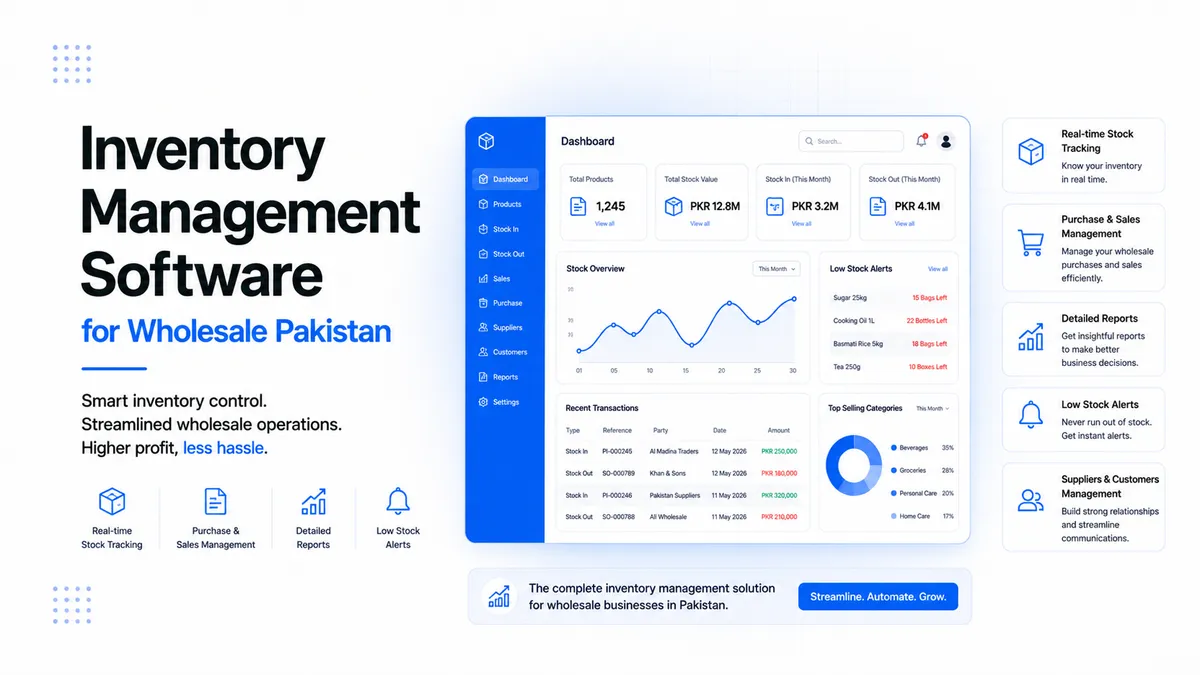
What Off the Shelf Software Really Gives You
Off the shelf software means a ready made product, something like an inventory or accounting platform that anyone can sign up for and start using the same afternoon. You pay a monthly or yearly fee, someone else hosts it, and updates arrive without you lifting a finger.
There is a real advantage here. No waiting weeks for development, no upfront build cost, and support documentation already exists somewhere online. If your wholesale operation mainly needs basic stock counts, simple invoicing, and a ledger that balances, an off the shelf tool can carry you for years without complaint.
The trouble starts when your business does not match what the software assumes about you. Most inventory platforms are built around one price list, one straightforward tax setup, and a sales process that goes from order to payment in a straight line. Wholesale in Pakistan almost never works that way. Gartner research has pointed out that businesses typically end up using only twenty to thirty percent of the features they are paying for in off the shelf products, simply because those products were designed for a broad audience rather than a specific trade. The rest of what you pay for each month sits there unused.
What Custom Software Actually Means
Custom software means the system is built around how your business already works, instead of asking your business to bend around someone else's design choices. For a wholesale operation this usually covers customer specific pricing, credit limit tracking that flags a buyer before they cross their allowed amount, dispatch scheduling, commission handling for sub dealers or field agents, and reports that already match the way your accountant thinks about the numbers rather than reports you have to reshape by hand every month.
The cost here is time and money spent upfront. Building something custom takes longer than clicking sign up on a SaaS website, and it needs a development partner who understands wholesale trade in Pakistan, not just software in general. Once it is built though, the system bends to fit your business as it grows, rather than you constantly working around a tool that was never meant for you.
The FBR Piece That Generic Software Often Gets Wrong
This part of the decision is not really optional once your numbers reach a certain point. Under the Sales Tax Act and recent FBR notifications, including SRO 1852(I)/2025, wholesalers and retailers who cross specific thresholds are required to connect their point of sale or invoicing system directly to FBR for real time reporting. You are generally pulled into this requirement if you operate from an air conditioned commercial space, accept card payments, have annual electricity billing above roughly Rs 1.2 million, or have paid advance withholding tax above Rs 100,000 as a wholesaler under Section 236G of the Income Tax Ordinance.
International SaaS products rarely build this in from day one, because FBR's real time invoice format with its QR code requirement is specific to Pakistan and nowhere else. A few local platforms have added it, but often as a bolt on feature that lives outside the normal sales screen rather than something built into the same flow your staff already use to record a sale. A custom system can put FBR reporting directly into that same screen, so nobody has to reconcile it separately later in the month.
If your business is well below these thresholds right now, none of this is urgent. If you are already moving high volumes of credit sales to distributors and dealers, it is worth checking your actual numbers against the FBR criteria before you commit to any software, not after you have already signed a year long contract.
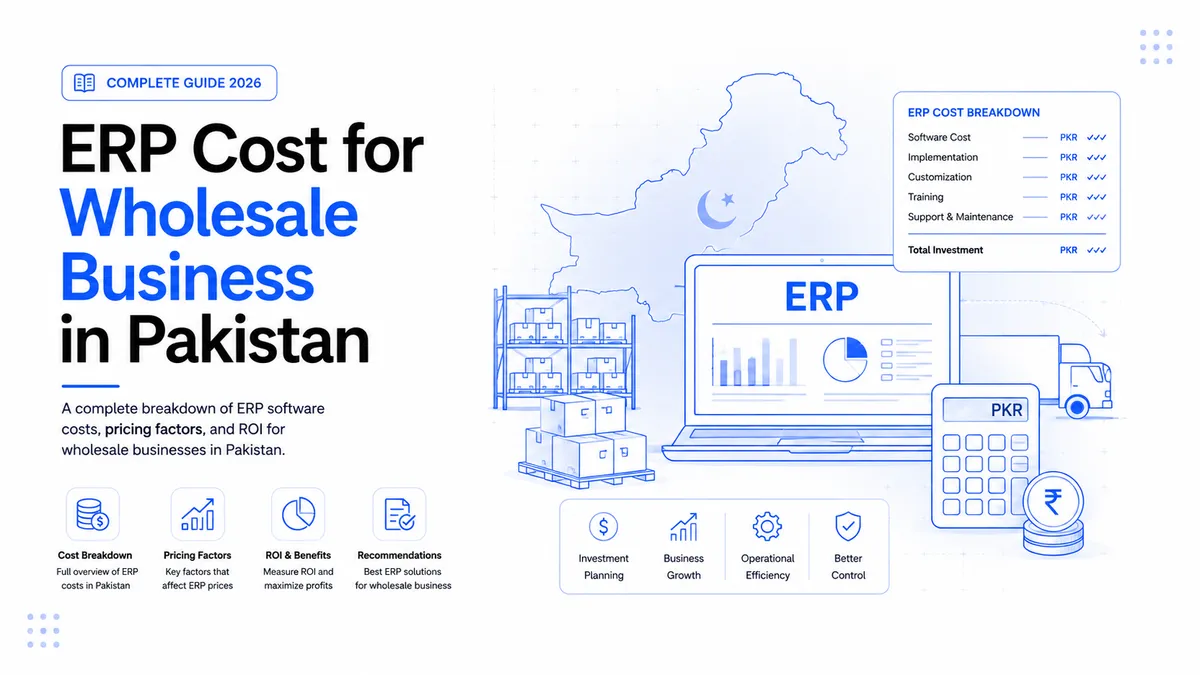
What This Actually Costs Over Time
The subscription price on a SaaS platform looks cheaper the moment you compare it to a custom quote, and for a small operation it usually is cheaper, at least at first. The picture changes once you look past the first invoice and think in terms of two or three years instead of two or three months.
With off the shelf software, watch for per user pricing that climbs as your team grows, paid add ons for features that probably should have been included from the start, and the cost of connecting the tool to your accounting software or to FBR reporting through some third party plugin that charges its own fee. Integration friction between separate systems is one of the most common reasons the real cost of running off the shelf software ends up higher than the number advertised on the pricing page.
With custom software, most of the spend happens upfront during planning and development. After that, costs drop noticeably since there is no per user license fee piling up and no vendor deciding on their own to raise prices or discontinue a feature your business depends on. You also stop waiting on someone else's product roadmap to catch up whenever an FBR rule changes.
If you want real numbers instead of general comparisons, ask your developer for a quote based on your actual process. A simple wholesale management build and a full system covering dispatch, commissions, and reporting across several branches are two very different projects, and the price should reflect what you actually need, not some generic package rate.
When Off the Shelf Is Genuinely the Smarter Choice
It would not be honest to pretend custom software is always the right call, so here is when sticking with a ready made tool makes more sense. Your business runs from one location with one pricing structure that applies to every customer the same way. You need something working this week, not this quarter. Your volume is still low enough that a staff member double checking things by hand is not a real burden. You are still testing whether your team will even adopt software properly before you commit real money to a bigger build.
In any of these situations, start with a solid off the shelf tool and use it properly for a while. Jumping into custom software before you understand your own workflow well enough to describe it clearly to a developer often means paying to build something that gets reworked six months later anyway.
A Simple Way to Check Where You Stand
Look honestly at how your business runs today, not how you hope it will run next year. Do a meaningful number of your customers get different prices or credit terms from each other. Is your monthly withholding tax or turnover getting close to the FBR thresholds mentioned earlier. Does your team quietly keep a parallel register or spreadsheet because the software you already pay for cannot capture something important about how you actually sell.
If two or more of those sound familiar, it is worth getting a proper quote for a custom or hybrid setup. If none of them apply yet, a good off the shelf tool will likely keep serving you fine for now.
Sources Referenced
SMEDA business count data, cited through a peer reviewed study on SME ecommerce adoption in Pakistan State Bank of Pakistan figures on SME contribution to the economy FBR Sales Tax Act, Sections 236G and 236H of the Income Tax Ordinance 2001, and SRO 1852(I)/2025 on POS integration Gartner research on feature utilization in off the shelf software
About the Author
Stuck Media is a knowledgeable contributor sharing expertise and insights on technology and business topics.
Comments
Leave a Comment
Your comment will be reviewed by our team before appearing.
Loading comments...