Inventory Management Software for Wholesale Pakistan
What should you actually look for in inventory management software for a wholesale business in Pakistan? A practical, no-nonsense buying guide.
How to Choose Inventory Management Software for Your Wholesale Business in Pakistan
Quick answer: The right inventory management software for a wholesale business in Pakistan depends on three things: whether it handles multi tier pricing for different customer types, whether it supports FBR compliant digital invoicing, and whether it can track stock across a warehouse and a sales team on the road at the same time. Off the shelf options typically cost PKR 2,500 to 15,000 per month, while custom built systems cost more upfront but adapt to how your business already operates instead of forcing you to change your process.
Search "best inventory management software Pakistan" and you'll find dozens of vendors, each claiming to be the top choice. Most of that content is written by the vendors themselves, which makes it hard to tell what actually matters for a wholesale business versus what's just a feature list padded out for a sales page.
This guide skips the rankings and focuses on what you should actually be evaluating, based on how wholesale and distribution businesses in Pakistan operate day to day.
Why Wholesale Inventory Management Is Different From Retail
A retail shop tracks stock for one storefront, sells at one price to walk-in customers, and usually deals with a manageable number of transactions per day.
A wholesale or distribution business is a different problem entirely. Stock often needs to be tracked across a warehouse and a fleet of sales vehicles simultaneously. Pricing changes depending on who's buying: a retail shop, a sub-dealer, and a bulk buyer often pay three different rates for the same item. Orders come in through multiple channels, sometimes a phone call, sometimes a sales rep visiting in person, sometimes a WhatsApp message.
Software built primarily for retail checkout counters tends to struggle with this. If you've tried adapting a retail POS system to a distribution business and found yourself working around its limitations instead of with them, this is why.
What to Actually Look For
Multi Tier Pricing Support
If your business sells the same product at different rates to different customer types, confirm the software handles this natively. A surprising number of systems marketed as "complete business solutions" only support a single price list per product, forcing staff to manually override prices for every order, which introduces errors and slows down billing.
Field Sales and Van Stock Tracking
If you have sales representatives taking orders in the field or vehicles delivering stock on fixed routes, look specifically for software that tracks stock loaded onto a vehicle separately from warehouse stock, and reconciles both at the end of the day. This is often referred to as PJP (Permanent Journey Plan) tracking or van sales management in Pakistani distribution software, and it's one of the more common gaps in generic inventory tools that weren't built with distribution in mind.
FBR Digital Invoicing Compliance
This has become a non negotiable requirement for many businesses over the past two years. If your business needs to issue FBR-compliant digital invoices, confirm this is built into the system before you commit, rather than something the vendor promises to "add later." Retrofitting compliance into a system that wasn't designed for it is more expensive and more error prone than choosing correctly from the start.
Real Time Stock Visibility
Ask specifically whether stock updates in real time or on a delayed sync. For a wholesale business processing dozens or hundreds of orders a day, a system that only updates stock counts every few hours can lead to selling inventory that's already been committed to another order, which is a common and entirely avoidable source of customer complaints.
Reporting That Matches How You Actually Make Decisions
Most systems generate reports. Fewer generate the specific reports a distribution business actually needs day to day: which products are moving slowly and tying up capital, which customers are approaching their credit limit, and which sales routes are underperforming. Ask to see actual report samples before buying, not just a features list that says "advanced reporting."
Off the Shelf vs Custom Built: The Real Trade off
Off the shelf inventory software in Pakistan typically ranges from PKR 2,500 per month for basic, industry specific tools (pharmacy inventory software, for example, tends to sit at the lower end) up to PKR 15,000 or more per month for more comprehensive distribution management platforms with field sales tracking included.
This works well if your business processes are fairly standard. Where it breaks down is when your business has a pricing structure, approval workflow, or operational quirk that doesn't match how the software assumes distribution businesses work. At that point, you're either paying for customization on top of a subscription, or working around the software's limitations indefinitely.
Custom built inventory and distribution software costs more upfront, generally starting in the range of PKR 100,000 to 300,000 for initial development depending on complexity, but it's built around your actual pricing structure, your actual sales process, and your actual reporting needs from day one. For businesses with a genuinely unusual model, or ones that have outgrown three or four different off the shelf tools already, this ends up being the more economical choice over a two to three year period, even though the upfront number looks larger.
If you're unsure which category your business falls into, the practical test is this: if you can describe your ideal system in a single sentence like "track stock, print invoices, manage customer pricing," an off the shelf tool will likely serve you well. If your description takes several paragraphs and includes phrases like "except when," custom development is probably worth the investment.
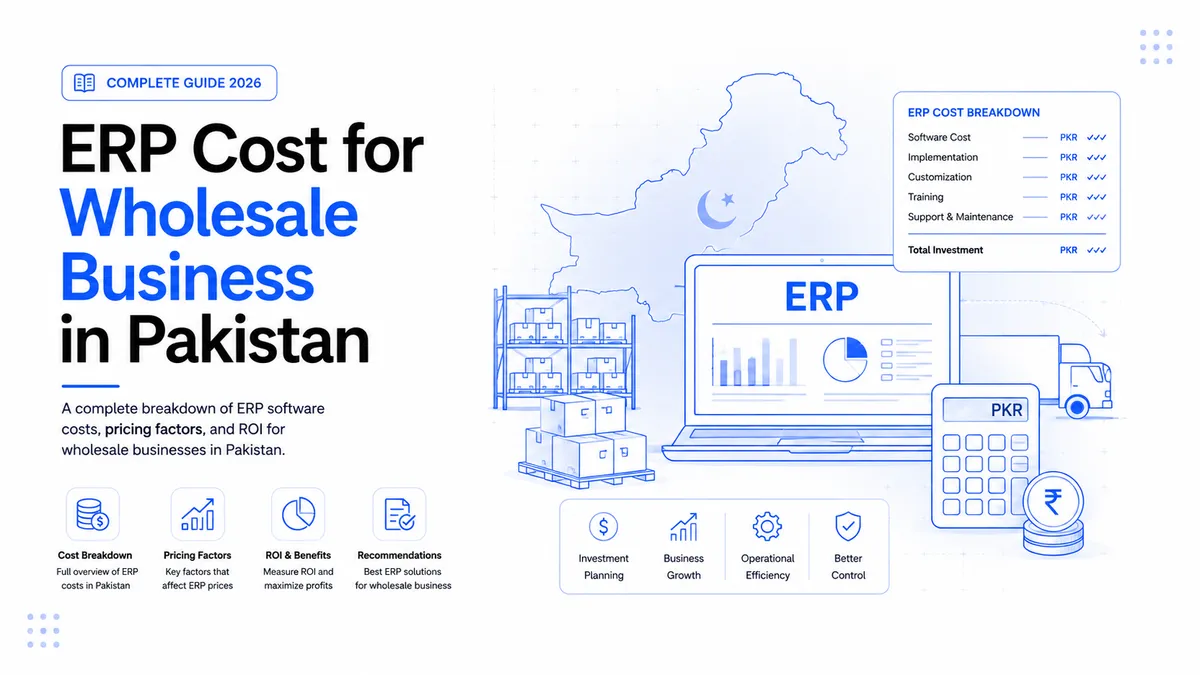
If you're also evaluating full ERP systems, see our breakdown of ERP costs for wholesale businesses in Pakistan.
Questions to Ask Before You Sign Anything
Before committing to any inventory management software, get clear, direct answers to the following:
- What is the actual monthly or one time cost, including setup and training, not just the advertised starting price?
- Is FBR digital invoicing included, or is it a separate add-on?
- How is data backed up, and who owns that data if you switch providers later?
- What happens to your historical data if you cancel or migrate to a different system?
- How long does implementation actually take for a business your size, based on their past clients, not their marketing page?
Vendors that answer these clearly and specifically, without redirecting to a sales call, are generally more trustworthy than ones that keep the conversation vague until you've committed.
The Bottom Line
There isn't a single "best" inventory management software for every wholesale business in Pakistan, despite what most comparison articles claim. The right choice depends on how your business actually operates: your pricing structure, whether you have a field sales team, and whether your reporting needs match what a generic tool provides out of the box.
Start by writing down your actual requirements before looking at any vendor's feature list. It's the only way to tell whether a system fits your business, or whether you're being sold on features you'll never use while missing the one feature you actually needed.
If you'd like a second opinion on whether an off the shelf tool will work for your business or whether it's worth building something custom, book a free consultation and we'll walk through your actual requirements with you.
Read: AI Agents for Business
About the Author
Stuck Media is a knowledgeable contributor sharing expertise and insights on technology and business topics.
Comments
Leave a Comment
Your comment will be reviewed by our team before appearing.
Loading comments...