AI Agents for Business
Master enterprise AI agents in 2026. Explore production architectures, multi agent orchestration, MCP integration, security guardrails, cost models, and ROI.
The Complete Enterprise Implementation Guide (2026)
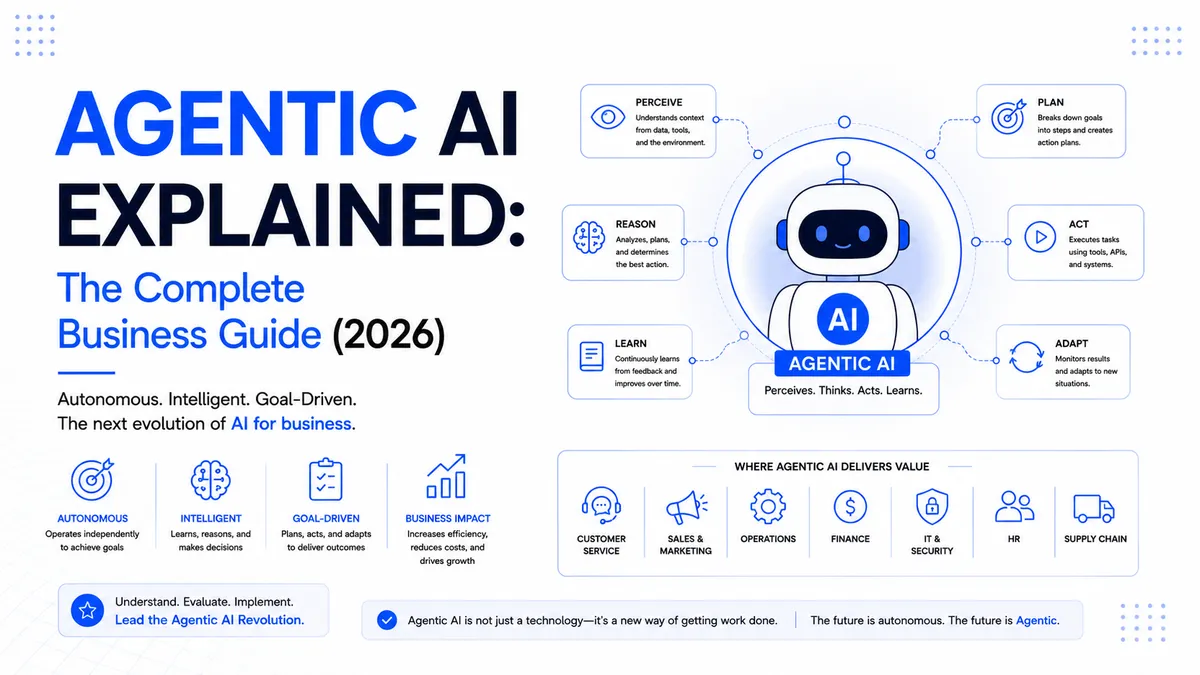
The era of rule based chatbots and simple prompt wrappers is officially over. Enterprise technology leaders are shifting toward Autonomous AI Agents goal driven digital workers capable of reasoning, selecting tools dynamically, breaking complex directives into multi step workflows, and executing tasks end to end across core infrastructure.
However, transitioning from basic prompt engineering to production grade agentic workflows introduces severe engineering, security, data residency, and governance challenges.
This guide outlines the proprietary frameworks, enterprise architectures, cost models, security protocols, and operational roadmaps required to design, deploy, and scale enterprise AI agents in 2026.
Methodology & Framework Origins
The frameworks and deployment models outlined in this document are derived from:
-
Stuck Media’s AI Engineering Engagements: Synthesized from enterprise integrations across financial services, supply chain operations, SaaS platforms, and healthcare.
-
Empirical Industry Benchmarks: Grounded in production studies from Gartner, McKinsey, and RAND Corporation tracking enterprise agent deployments through 2026.
-
The Enterprise AI Framework™: Stuck Media's unified methodology connecting enterprise integration, autonomous workflows, observability, and compliance into a singular engineering standard.
1. What Is an AI Agent? (The Operational Spectrum)
To construct an effective AI strategy, executive leadership must distinguish between deterministic script execution, conversational knowledge retrieval, and true agentic autonomy.
AI Automation Technology Comparison
| Feature / Dimension | RPA / Rule Based Systems | Conversational AI (Chatbots / RAG) | Autonomous AI Agents |
|---|---|---|---|
| Execution Model | Rule Based (If Then Logic) | Context Aware Information Retrieval | Goal Oriented Decision Making |
| Primary Trigger | Predefined UI or API Actions | Natural Language Prompts | High Level Business Objectives |
| Handling Edge Cases | Stops on Errors or UI Changes | Responds but Cannot Take Actions | Self Plans, Retries, and Adapts |
| Tool Usage | Fixed APIs and Scripts | Knowledge Retrieval (RAG) | Autonomous Tool & API Selection |
| Primary Business Value | AI Process Automation | Knowledge Discovery & Customer Support | End to End AI Workflow Automation |
Evolution of Intelligent Automation
RPA
(Rule Based Automation)
          │
          ▼
Conversational AI
(Chatbots & RAG)
          │
          ▼
Autonomous AI Agents
(Goal Driven Automation)
- A chatbot tells you what to do, RPA repeats a static click path, but an AI agent reasons, selects tools, and executes the entire process independently.
The AI Agent Paradigm Shift
-
Traditional Chatbots: Informative. They summarize data or retrieve knowledge via basic RAG (Retrieval Augmented Generation) and wait for a human to act.
-
RPA Systems: Brittle. They execute static, pre recorded visual scripts that break whenever UI layouts or underlying API schemas shift.
-
AI Agents: Autonomous & Resilient. They receive an abstract objective (e.g., "Reconcile Q2 vendor payment discrepancies exceeding $5,000"), decompose it into structured sub tasks, select appropriate tools via standard interfaces, execute REST/SQL operations,
2. Decision Tree: Do You Need an AI Agent?
Before committing engineering resources, use this operational decision logic:
AI Solution Decision Tree
Does the task require actions across multiple tools?
                     │
          ┌──────────┴──────────┐
         No                    Yes
          │                     │
          ▼                     ▼
Deploy Conversational AI     Are the rules
(Chatbot / RAG)              deterministic?
                                   │
                        ┌──────────┴──────────┐
                       Yes                   No
                        │                     │
                        ▼                     ▼
                 Deploy RPA / Scripts   Multiple departments?
                                              │
                                   ┌──────────┴──────────┐
                                  No                   Yes
                                   │                     │
                                   ▼                     ▼
                           Single AI Agent      Multi Agent System
3. The Anatomy of an Enterprise AI Agent™
An enterprise-ready AI agent consists of five tightly coupled layers. Designing these layers properly prevents hallucination loops and unauthorized system writes.
Enterprise AI Agent Architecture
| Layer | Core Component | Operational Responsibility | Enterprise Standard |
|---|---|---|---|
| 1. Perception | Ingestion Engine | Processes documents, APIs, webhooks, JSON, and event streams | Event Driven Architecture |
| 2. Reasoning | LLM Engine | Creates execution plans, reasoning steps, and tool selection | Private or Fine Tuned AI Models |
| 3. Memory | Short Term & Long Term Storage | Maintains conversation context and long term knowledge | Vector Database (pgvector / Pinecone) |
| 4. Tool Integration | API Connectors | Connects AI agents with enterprise systems and SaaS applications | MCP & OpenAPI Standards |
| 5. Guardrails | Validation & Security Layer | Enforces schema validation, RBAC, compliance, and human approval | Deterministic Middleware & Human in the Loop |
Enterprise AI Agent Stack
Layer 5 ─ Guardrails
          │
Layer 4 ─ Tool Integration
          │
Layer 3 ─ Memory
          │
Layer 2 ─ Reasoning
          │
Layer 1 ─ Perception
- The agent acts like an operational team: the Brain thinks, Memory remembers history, the Tool Belt operates software, and Guardrails ensure no unauthorized actions take place.
4. Enterprise Architecture: Multi Agent Orchestration
Single agent architectures frequently experience performance issues when assigned broad operational scopes. Enterprise workflows require Multi Agent Systems (MAS) with explicit role boundaries, supervisor routing, and fallback mechanisms.
Multi Agent AI Architecture
                    ┌────────────────────────────┐
                    │      User / Webhook        │
                    └─────────────┬──────────────┘
                                  │
                                  ▼
                    ┌────────────────────────────┐
                    │      Supervisor Agent      │
                    │ (Orchestrator / Router)    │
                    └─────────────┬──────────────┘
                                  │
                ┌─────────────────┴─────────────────┐
                │                                   │
                ▼                                   ▼
      ┌───────────────────┐              ┌───────────────────┐
      │  Research Agent   │              │ Execution Agent   │
      │ • Vector Search   │              │ • API Calls       │
      │ • Web Retrieval   │              │ • SQL / ERP Write │
      └─────────┬─────────┘              └─────────┬─────────┘
                └─────────────────┬─────────────────┘
                                  │
                                  ▼
                    ┌────────────────────────────┐
                    │ Human Verification Gateway │
                    │   (Human in the Loop)      │
                    └─────────────┬──────────────┘
                                  │
                                  ▼
                    ┌────────────────────────────┐
                    │   Audit Log & ERP Update   │
                    └────────────────────────────┘
Technical System Flow
-
Ingestion: Incoming requests arrive at the Supervisor Agent.
-
Routing: The Supervisor breaks down the task and routes queries to specialized sub agents.
-
Execution: The Research Agent fetches context via RAG, while the Execution Agent formats mutation payloads.
-
Verification: High impact operations route to a Human in the Loop Gateway prior to final execution.
-
Persistence: Successfully approved operations trigger downstream ERP writes via custom AI Integration Services and append immutable audit logs.
5. Enterprise AI Agent Technology Stack (2026)
Building production systems requires choosing compatible components across the agent stack:
Enterprise AI Technology Stack
| Layer | Primary Frameworks & Tools | Selection Criteria |
|---|---|---|
| Foundation Models | Claude 3.5/3.7, GPT-4o/O1, Llama 3.3, Gemini 1.5 Pro | Tool calling accuracy, context window, response latency |
| Agent Frameworks | LangGraph, CrewAI, AutoGen, LlamaIndex | Multi agent orchestration, state management, loop control |
| Vector Storage | Pinecone, pgvector, Weaviate, Qdrant | Hybrid search, performance, enterprise compliance |
| Integration Layer | Model Context Protocol (MCP), REST APIs, GraphQL, Temporal | Standardized integrations and durable workflow execution |
| Observability & Tracing | LangSmith, Arize Phoenix, Helicone, Traceloop | Monitoring, token usage, debugging, latency analysis |
| Security & Identity | HashiCorp Vault, Okta (OAuth 2.0), AWS KMS | Secrets management, RBAC, authentication, encryption |
Enterprise AI Stack
Security & Identity
        ▲
Observability & Tracing
        ▲
Integration Layer
        ▲
Vector Storage
        ▲
Agent Frameworks
        ▲
Foundation Models
6. The AI Agent Readiness Index™
Evaluating operational readiness across four technical dimensions reduces deployment failures before engineering begins:
Enterprise AI Readiness Assessment
| Readiness Dimension | Evaluation Criteria | Target Score | Critical Risk Factors |
|---|---|---|---|
| Data Quality & Structure | Structured data, standardized schemas, searchable knowledge base | 80 / 100 | Unstructured documents, inconsistent or duplicate records |
| API Infrastructure | Reliable REST APIs, MCP support, secure authentication | 75 / 100 | Legacy systems with no API support or UI only integrations |
| Process Documentation | Well defined SOPs and repeatable business workflows | 70 / 100 | Informal processes, undocumented decisions, tribal knowledge |
| Governance & Security | RBAC, approval workflows, audit logging, compliance controls | 90 / 100 | Missing access controls, inadequate audit trails, weak governance |
AI Readiness Scorecard
Data Quality & Structure      ████████████████  80/100

API Infrastructure            ███████████████   75/100

Process Documentation         ██████████████    70/100

Governance & Security         ██████████████████ 90/100
Assessment Guidelines
- 90–100: Enterprise ready
- 75–89: Ready with minor improvements
- 60–74: Requires preparation before AI implementation
- Below 60: Significant foundational work recommended
Architectural Rule: If an operational workflow cannot be mapped into a deterministic flowchart for human workers, it cannot be safely automated with an autonomous AI agent. Consult our guide on Intelligent Automation to standardize processes first.
7. Security, Compliance & Threat Management
As agents move from read only search functions to active API execution, security becomes critical.
Enterprise AI Security Risk Matrix
| Threat Vector | Risk Description | Engineering Mitigation Strategy |
|---|---|---|
| Indirect Prompt Injection | Malicious content in retrieved documents manipulates AI behavior | Sanitize inputs, separate instructions from context, and perform secondary validation |
| Excessive Agent Permissions | AI agent performs unauthorized actions or modifies critical systems | Apply least privilege access, role based permissions (RBAC), and read only replicas where appropriate |
| Data Leakage & PII Exposure | Sensitive business or customer data is sent to external AI services | Use PII redaction, private VPC endpoints, encrypted communication, and strict data boundaries |
| Broken Function Authorization | Users gain access to unauthorized tools or actions through AI | Enforce authorization at the backend API layer rather than relying solely on LLM prompts |
Security Principles
Input Validation
        │
        ▼
Access Control (RBAC)
        │
        ▼
Data Protection
        │
        ▼
Backend Authorization
Key Security Controls
-
Validate all AI inputs before processing.
-
Enforce Role Based Access Control (RBAC).
-
Protect sensitive data with encryption and private infrastructure.
-
Perform authorization checks in backend services not inside AI prompts.
-
Maintain comprehensive audit logs for compliance and traceability.
-
Security isn't just asking the AI to "be safe" it requires hard code guardrails around the AI that physically block unauthorized database modifications or data leaks.
8. AI Agent Observability & Telemetry
Production agent systems require specialized observability platforms to track execution trajectories and cost metrics.
AI Agent Performance Monitoring
| Telemetry Metric | Target Benchmark | Remediation Action |
|---|---|---|
| Step-Level Accuracy | > 98% | Pause workflow and route to a human reviewer for verification. |
| Trajectory Latency | < 2.5s (Real-Time) < 30s (Batch Jobs) | Optimize prompt size, reduce context, and enable result caching. |
| Tool Failure Rate | < 1.0% | Retry with exponential back off and switch to a fallback workflow or agent. |
| Cost Per Workflow | Within predefined token budget | Compress prompts, optimize context, or use a lower cost AI model. |
| Human Override Rate | < 5.0% | Review prompts, business rules, and workflow logic to improve automation accuracy. |
AI Operations Dashboard
Step Accuracy          > 98%
Latency                < 2.5s / < 30s
Tool Failure Rate      < 1.0%
Cost Per Workflow      Within Budget
Human Override Rate    < 5.0%
Operational Goals
- Maintain high accuracy with minimal human intervention.
- Keep response times low for both real time and batch workflows.
- Reduce API failures through automated retries and fallback mechanisms.
- Control AI costs with efficient prompt management and model selection.
- Continuously monitor performance to ensure reliable enterprise operations.
9. Failure Analysis: Anti-Patterns & Root Causes
Industry research indicates that over 40% of enterprise AI agent initiatives face cancellation or decommissioning due to cost overruns, security issues, and unexpected execution errors.
The 10 Enterprise AI Agent Anti Patterns
| # | Anti Pattern | Why It's a Problem |
|---|---|---|
| ❌ 1 | Monolithic Agent | One agent handles every business task, creating complexity and poor scalability. |
| ❌ 2 | Unbounded API Keys | Agents have unrestricted read/write access to enterprise systems. |
| ❌ 3 | Missing Retry Backoffs | Failed API requests trigger endless retries and unnecessary system load. |
| ❌ 4 | Context Overloading | Excessive logs and documents overwhelm the AI model, reducing accuracy and increasing cost. |
| ❌ 5 | Missing Approval Workflows | Critical business actions execute without human verification. |
| ❌ 6 | Direct Database Writes | Agents write directly to databases without validation or safeguards. |
| ❌ 7 | No Trajectory Tracing | Lack of logging makes debugging and auditing AI decisions impossible. |
| ❌ 8 | Ignoring Token Costs | Uncontrolled prompts and agent loops lead to excessive AI expenses. |
| ❌ 9 | Rigid Multi Step Workflows | Hardcoded execution paths fail when real world conditions change. |
| ❌ 10 | Agent Washing | Rebranding traditional RPA or chatbots as "AI agents" without true autonomous capabilities. |
Best Practices
✓ Specialized Agents
✓ Least Privilege Access
✓ Retry & Fallback Logic
✓ Optimized Context
✓ Human Approval
✓ Validated Database Writes
✓ Complete Audit Logs
✓ Cost Monitoring
✓ Adaptive Workflows
✓ Genuine Autonomous AI
10. Industry Deployment Case Studies
-
Case Study: Manufacturing & Logistics Supply Chain
-
Operational Challenge: A global distributor faced shipping delays due to manual inventory reconciliation across three ERPs and custom warehouse systems.
-
Agentic Solution: Deployed a Multi Agent System consisting of an Ingestion Agent (parsing supplier invoices), a Reconciliation Agent (checking stock levels), and an Execution Agent.
-
Governance Control: Reorders exceeding $10,000 automatically trigger a Human in the Loop review via Slack/Teams.
Case Study: Financial Services Exception Processing
-
Operational Challenge: A commercial bank spent thousands of hours reviewing dispute exceptions manually across legacy core systems.
-
Agentic Solution: Integrated custom agents using AI Automation Software and MCP connectors to fetch transaction history, verify compliance policies, and format dispute files.
-
Measurable Impact: Transaction handling time fell from 45 minutes to under 3 minutes per case, with 99.4% accuracy. Measurable Impact: 82% reduction in manual reconciliation time and a 40% drop in stock out events.
11. Cost Drivers & ROI Framework
Deploying enterprise AI agents involves infrastructure, model inference, token usage, and continuous maintenance.
Key Investment Drivers
-
**System Integration Complexity:*8 The cost scales directly with the number of legacy systems (ERP, CRM, custom databases) requiring custom API or MCP interfaces.
-
State Management & Memory Infrastructure: Enterprise systems requiring vector search over millions of records demand ongoing database compute.
-
Governance & Human in the Loop Customization: Building secure approval interfaces adds initial engineering effort but limits long term operational risk.
AI Agent Implementation Investment Tiers
| Engagement Tier | Scope & Capabilities | Investment Range | Primary Cost Drivers |
|---|---|---|---|
| Proof of Concept (PoC) | Single AI agent, internal testing, standard RAG implementation | $15,000 – $30,000 | Initial architecture, prompt engineering, prototype development |
| Mid-Market Deployment | Multi agent departmental automation with custom MCP integrations | $40,000 – $95,000 | API integrations, workflow orchestration, security, state management |
| Enterprise Platform | Cross ERP automation, private VPC deployment, custom AI models | $100,000 – $300,000+ | High availability, compliance, enterprise security, monitoring, custom development |
Implementation Journey
Proof of Concept
      │
      ▼
Mid Market Deployment
      │
      ▼
Enterprise Platform
Typical Progression
- PoC: Validate the business case with a focused AI solution.
- Mid-Market: Expand automation across departments with secure integrations.
- Enterprise: Deploy organization wide AI with enterprise grade security, governance, and scalability.
The AI Agent ROI Equation
Calculate net monthly savings with this formula:
Net Monthly ROI Formula
Formula
Net Monthly ROI
=
(Hours Saved × Blended Hourly Rate)
−
(Inference Token Costs + Hosting Costs + Maintenance Costs)
Variables
| Variable | Description |
|---|---|
| Hours Saved | Total employee hours saved per month through AI automation |
| Blended Hourly Rate | Average fully loaded hourly labor cost |
| Inference Token Costs | Monthly AI model/API usage costs |
| Hosting Costs | Cloud infrastructure and compute expenses |
| Maintenance Costs | Ongoing monitoring, support, and system maintenance |
Interpretation
This formula calculates the net monthly financial return generated by an AI automation system after subtracting all operational expenses from the labor savings.
12. Build vs. Buy Decision Matrix
Off the Shelf vs Custom Enterprise AI Agents
| Evaluation Factor | Off the Shelf SaaS Agent | Custom Enterprise Build | Strategic Guidance |
|---|---|---|---|
| Intellectual Property | Vendor owned platform with limited customization | 100% proprietary code and IP ownership | Choose a custom build when AI workflows are a core competitive advantage. |
| Security & Privacy | Shared multi tenant cloud environment | Private VPC or on premises deployment | Custom deployments are recommended for regulated or security sensitive industries. |
| Integration Flexibility | Limited to pre built connectors | Custom REST APIs, GraphQL, MCP, and legacy system integrations | Best for organizations with proprietary or complex enterprise systems. |
| Long Term Scaling Costs | Per user or subscription fees increase with usage | Fixed infrastructure with usage based AI costs | Custom solutions typically become more cost effective at enterprise scale. |
Build vs Buy
Small Team / Standard Needs
            │
            ▼
   Off the Shelf SaaS
            │
            ▼
Growing Business
            │
            ▼
 Hybrid Approach
            │
            ▼
Enterprise / Regulated Industry
            │
            ▼
 Custom AI Platform
For a complete strategic evaluation, review our detailed guide on [AI Automation Consulting[(https://www.stuckmedia.com/blog/ai-automation-consulting).
13. Enterprise Launch Checklist & Implementation Roadmap
Enterprise AI Agent Implementation Roadmap
Phase 1: Readiness Assessment (Weeks 1–2)
│
├─ Assess AI readiness
├─ Map business processes (SOPs)
└─ Identify available APIs & integrations

        │
        ▼

Phase 2: Architecture & Security Design (Weeks 3–4)
│
├─ Select technology stack
├─ Configure MCP / API integrations
└─ Design security guardrails & governance

        │
        ▼

Phase 3: PoC Development & Validation (Weeks 5–8)
│
├─ Build AI agent workflows
├─ Perform security & adversarial testing
└─ Implement Human in the Loop approval

        │
        ▼

Phase 4: Pilot Deployment & Monitoring (Weeks 9–12)
│
├─ Deploy to pilot users
├─ Monitor with observability tools
└─ Track performance, latency & AI costs

        │
        ▼

Phase 5: Production Scale & Optimization (Week 13+)
│
├─ Expand across departments
├─ Reduce manual approvals as confidence grows
└─ Continuously optimize performance, security & costs
Pre Launch Checklist
-
SOPs documented and approved by department leads.
-
API specs (OpenAPI/MCP) validated with write permissions configured.
-
Dual memory vector databases set up and populated with company data.
-
Human in the Loop review portals active for high value actions.
-
Observability platform connected with spending alert thresholds.
-
Security reviews completed for prompt injection defense and PII protection.
-
Operational baseline KPIs established to track project ROI.
Frequently Asked Questions
What is the Model Context Protocol (MCP)?
Model Context Protocol (MCP) is an open standard designed to simplify connections between AI applications and external data sources or execution tools. It replaces custom integration code with a uniform interface, allowing agents to access database pipelines, internal software, and external APIs securely.
How do you prevent AI agents from executing unintended commands?
Enterprise agent deployments use deterministic middleware isolated from the core LLM. Function calls generated by the model pass through validation layers to verify parameters against predefined schemas. Any action exceeding defined safety thresholds or financial boundaries halts execution until approved by a human reviewer.
What is the primary difference between RAG and Agentic AI?
Retrieval Augmented Generation (RAG) is a retrieval mechanism that fetches relevant documents to enhance static LLM outputs. Agentic AI is an active operational architecture that evaluates high level objectives, decides which tools or RAG pipelines to run, inspects execution results, and updates connected business systems.
Related Guides & Topic Cluster
To build a complete understanding of enterprise AI automation, explore the other resources in our knowledge base:
-
What is AI Automation: The foundational executive overview of enterprise machine intelligence.
-
AI Integration Services: How to connect modern AI infrastructure to legacy ERP and database architectures.
-
Enterprise AI Integration: Strategic implementation guide for enterprise scale AI architecture.
-
AI Automation Solutions: End to end automation frameworks designed for scaling businesses.
About the Author
Stuck Media is a knowledgeable contributor sharing expertise and insights on technology and business topics.
Comments
Leave a Comment
Your comment will be reviewed by our team before appearing.
Loading comments...