Agentic AI
Discover how Agentic AI transforms enterprise software from passive chatbots to autonomous digital workers. Includes architecture, ROI frameworks, and case studies.
The Complete Business Guide (2026)
EXECUTIVE BRIEFING
Agentic AI is an enterprise software paradigm where autonomous systems plan, execute, and adapt multi step workflows to achieve business outcomes with minimal human intervention. Unlike static automation or generative chatbots, Agentic AI connects directly to operational tools (CRMs, ERPs, databases) via protocols like MCP to own end to end execution under strict policy guardrails.
For years, enterprise software followed simple, rigid rules: if event X occurs, execute action Y. When generative AI arrived, it brought dynamic natural language generation, but it still required a human operator behind the keyboard prompting every single turn.
In 2026, enterprise technology is undergoing a structural shift: software is transitioning from a passive tool sitting on a screen to an active digital worker running zero touch operations. According to Gartner, 40% of enterprise applications feature task-specific AI agents in 2026 (up from under 1% in 2024), driving global spending on agentic AI to over $200 billion.
This shift is driven by Agentic AI a design paradigm where intelligent systems evaluate operational goals, construct multi step plans, select internal software tools via modern standards like the Model Context Protocol (MCP), execute actions, and adapt dynamically when exceptions arise.
Agentic AI Operational Loop
[ PERCEIVE ] --> [ PLAN ] --> [ EXECUTE ] --> [ EVALUATE ]
What Is Agentic AI?
Agentic AI refers to an architectural framework where software operates with goal directed autonomy. Traditional enterprise software requires explicit, hardcoded scripts. If a process encounters an unmapped edge case, traditional software halts and throws an error.
In contrast, an agentic system is given an outcome rather than a rigid step by step program. When handed a broad business objective—such as "Investigate why customer onboarding dropped in Region B and issue corrective billing credits to affected accounts" it follows an autonomous four-step execution loop:
2. Perceive: Ingests alerts, database logs, and support tickets via standard webhooks and APIs.
2. Plan: Decomposes the overarching objective into an ordered series of sub tasks using reasoning chains.
3. Execute: Interacts directly with enterprise software (CRM, financial ledger, database) using secure API tool interfaces.
4. Evaluate & Adapt: Inspects the results of its own execution. If an API call fails or returns an anomaly, it recalculates its trajectory using self healing architecture without throwing a blind exception.
Agentic AI vs AI Agents
While these terms are frequently used interchangeably across social media and tech podcasts, there is a clear distinction in engineering scope:
-
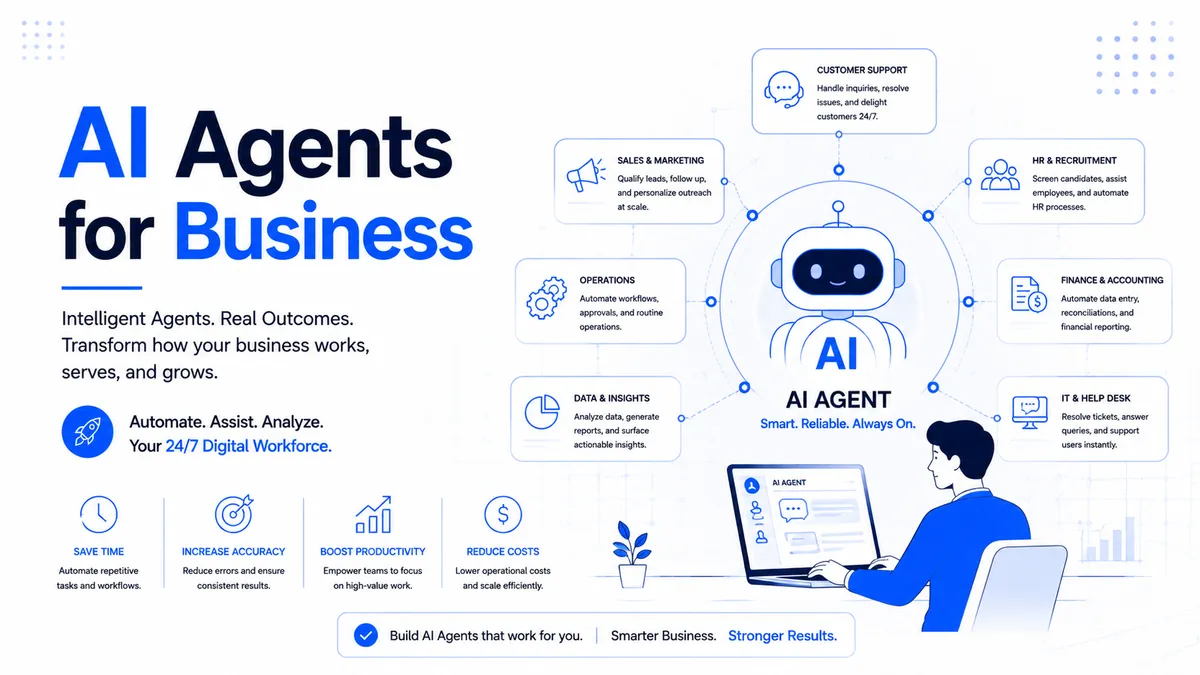
AI Agents: A single purpose, task focused digital worker designed to handle specific inputs. For example, a specialized AI Agent might listen to an inbound support queue, extract invoice numbers, and output a structured JSON response.
-
Agentic AI: The overarching umbrella paradigm and orchestration system that coordinates multiple AI agents, memory layers, decision graphs, and enterprise connectors into an autonomous end to end business workflow.
For organizations transitioning from static bots to dynamic decision makers, implementing comprehensive Intelligent Automation strategies ensures these individual agents work in harmony.
Agentic AI vs Generative AI
Understanding how Agentic AI builds upon foundation models is essential for enterprise decision makers evaluating their technology stack:
Generative AI vs. Agentic AI
| Dimension | Generative AI | Agentic AI |
|---|---|---|
| Core Function | Generates text, images, code, and other content | Executes goals, uses tools, and completes workflows |
| User Role | User provides prompts for every step | User defines goals while AI performs tasks autonomously |
| System Access | Chat interface and prompt based interaction | Enterprise APIs, databases, vector stores, and business systems |
| Operational Impact | Improves individual productivity and content creation | Automates end to end business processes with minimal human intervention |
While conversational interfaces built through traditional AI Chatbot Development enhance customer interaction, Agentic AI takes the next step by granting systems write access to solve problems directly behind the scenes.
Is Agentic AI Right for Your Business?
Gartner Warning: Over 40% of agentic AI projects will be canceled by 2027 due to escalating costs, unclear business value, or inadequate risk controls. Deploying Agentic AI where simple scripts or human oversight are better suited leads to wasted capital.
Enterprise Adoption Decision Tree
Is Agentic AI Right for Your Process?
- Does the workflow require multi step reasoning and tool access?
- No → Use Traditional Automation / RPA
- Yes
- Are REST APIs, GraphQL APIs, or MCP interfaces available?
- No → Improve your Data & API Infrastructure first
- Yes
- Does the process exceed 300 executions per day or $50k/month in labor costs?
- No → Use Human Assisted AI Copilots
- Yes → Deploy an Agentic AI Workflow
Readiness & Disqualifier Matrix
Agentic AI Readiness Checklist
| Evaluation Factor | Ideal Candidate | Not a Good Fit |
|---|---|---|
| Process Volume | 300+ executions/day or $50,000+/month in manual labor | Low-volume, highly subjective tasks (<10 executions/week) |
| API Readiness | REST, GraphQL, or MCP APIs with structured JSON | Legacy systems requiring screen scraping and no APIs |
| Rule Maturity | Documented SOPs, clear workflows, and defined business rules | Undocumented processes relying on employee knowledge |
| Budget | $35,000–$75,000+ allocated for implementation | Expecting a low cost "plug and play" bot for complex enterprise workflows |
If your team needs help evaluating process readiness and setting up proper infrastructure, our AI Automation Consulting team provides end to end feasibility audits before code is written.
Proprietary Insights: 3 Deployment Anti Patterns
Through engineering autonomous systems for enterprise clients, Stuck Media has identified three primary failure modes that stall agentic implementations and the production patterns required to solve them:
STUCK MEDIA® Field Lessons & Production Fixes
| Anti Pattern | Production Fix |
|---|---|
| Infinite Loop Trap | Bounded state machines (LangGraph) with dynamic token limits |
| Context Window Bloat | Schema pruning and micro context state passing |
| Unchecked API Side Effects | Idempotency keys and two-phase commit (Saga) patterns |
1. The Infinite Loop Trap: Unbounded ReAct loops can get stuck repeatedly calling a failing API.
- The Fix: Replace open ended conversation loops with Directed Acyclic Graphs (DAGs) enforcing hard step limits (max 10 iterations) and auto-escalating to human queues upon 3 consecutive tool errors.
2. Context Window Bloat: Passing complete chat transcripts across every tool turn causes token costs to explode and increases model hallucination rates.
- The Fix: Implement micro context state passing, where agents output typed, validated JSON payloads to a centralized state store (e.g., Redis or PostgreSQL) rather than re sending raw chat logs.
3. Unchecked API Side Effects: Executing non idempotent write operations across payment gateways or CRMs leads to duplicate charges during retry loops.
- The Fix: Mandate deterministic Idempotency Keys and two phase commit saga patterns across all tool endpoints integrated into your AI Integration pipeline.
Enterprise Agentic AI Architecture
Moving beyond basic demos requires architectural patterns designed for idempotency, fault isolation, state persistence, and cost containment.
Enterprise Agentic AI Architecture
| Layer | Core Components |
|---|---|
| 1. Perception | Webhooks, REST APIs, GraphQL APIs, Data Streams, Real Time Events |
| 2. Reasoning | LLMs (Claude, GPT), ReAct Reasoning, Planning, Task Decomposition |
| 3. Memory | Short Term Context, Long-Term Memory, Vector Databases (pgvector) |
| 4. Tool Integration | Model Context Protocol (MCP), Enterprise APIs, Database Connectors |
| 5. Governance | Policy Enforcement, Schema Validation, Human Approval, Audit Logs |
Building scalable architecture requires aligning your infrastructure with custom Enterprise AI Automation standards to secure internal data networks.
Agentic AI Workflow in Action
How does an enterprise workflow move from trigger to resolution without manual intervention?
!. Event Ingestion: An anomaly or webhook fires (e.g., an enterprise billing dispute email is received).
2. Context Enrichment: The agent queries long-term vector DBs and historical CRM logs to gather full background context.
3. Task Decomposition: The reasoning model breaks the problem into discrete execution steps.
4. Deterministic Validation: Before executing a state changing API call, policy guardrails check if the action meets internal compliance rules.
5. Execution & Verification: The action is triggered via REST API. If the call succeeds, the state is recorded; if it fails, fallback routes engage.
To implement these autonomous loops seamlessly across your technology stack, explore our specialized AI Automation capabilities and tailored AI Automation Solutions.
Key Enterprise Benefits
1. Massive Throughput Scaling: Businesses scale operational capacity without linear headcount expansion.
2. Reduced Handling Time: Complex multi system processes drop from business days to mere minutes.
3. Deterministic Accuracy: Policy engines enforce compliance rules across 100% of transactions.
4. Resilient Self Healing Workflows: When edge case API errors occur, agentic systems automatically re plan around system outages.
By deploying structured AI Workflow Automation, businesses eliminate repetitive administrative overhead while retaining complete visibility over execution paths.
Challenges & Risks
-
Context Creep & Token Costs: Without strict state pruning, long reasoning loops can consume excess tokens.
-
Cascading Failures: Unbounded multi agent chatter can lead to execution deadlocks if hard step limits are absent.
-
Governance & Authorization: Granting write access to enterprise tools requires robust, role based access control (RBAC).
Transforming legacy manual tasks using modern AI Process Automation addresses these challenges by embedding hard compliance gates directly into execution workflows.
Real World Enterprise Case Studies
1. Freight Logistics & Dispute Resolution
-
The Challenge: A logistics provider faced a backlog of 14,000 monthly freight claims across legacy billing portals and customer emails.
-
The Agentic Solution: An agentic workflow ingested unstructured dispute logs, cross referenced warehouse sensor data, evaluated the claim against contract terms, and automatically issued credits for low value claims under $500.
-
The Result: Average processing duration fell from 4.2 business days to 3.5 minutes, reducing processing expenses by 78%.
2. Autonomous B2B Lead Enrichment & Routing
-
The Challenge: Inbound enterprise leads sat unassigned for hours while SDRs manually compiled company telemetry.
-
The Agentic Solution: An agentic system triggered instantly upon form submission, scraped tech stack details, checked historical CRM records, enriched profile data, and assigned high intent buyers directly to senior account executives.
The Future of Agentic AI (2026–2028 Bold Predictions)
Enterprise Agentic AI Roadmap
| Year | Key Milestones |
|---|---|
| 2026 | Model Context Protocol (MCP) adoption, Human in the Loop (HITL) governance, enterprise guardrails |
| 2027 | Cross enterprise multi agent systems, autonomous B2B workflows, secure agent to agent communication |
| 2028 | Physical AI integration, autonomous operations, Zero Trust agent identity and authorization frameworks |
!. MCP Replaces Custom API Adapters (2026): The Model Context Protocol (MCP) becomes the universal connectivity standard, making custom REST integration glue code obsolete for enterprise agents.
2. Cross Enterprise Agentic Swarms (2027): Agents will no longer be confined to internal enterprise walls. Vendor agents will negotiate SLAs, inventory orders, and billing adjustments directly with buyer agents via encrypted B2B protocols.
3. Zero Trust Agent Identity & Auth (2028): Just as human employees require SAML/SSO identities, autonomous agents will operate under cryptographic, time bound OAuth tokens restricted by specific action scopes.
Enterprise Frequently Asked Questions
What is the difference between an AI Agent and Agentic AI?
An AI Agent focuses on executing a single task, whereas Agentic AI represents the orchestration framework and architecture that coordinates multiple agents, memory stores, decision graphs, and software tools to achieve end to end business outcomes.
How does Agentic AI ensure safety and compliance?
Agentic AI systems separate reasoning from execution. Before any state changing action is executed, deterministic policy engines validate permissions, while high risk operations pause for supervisor approval via Human in the Loop (HITL) guardrails.
What is the Model Context Protocol (MCP)?
MCP is an open standard designed to simplify connections between AI applications and business software tools. It provides a uniform interface that allows agents to read and write data securely across software environments without custom integration code for every tool.
How much does it cost to deploy an Enterprise Agentic AI workflow?
Initial production deployments typically range from $35,000 to $75,000+, covering process scoping, custom MCP connector engineering, state persistence setup, guardrail policy configuration, and sandbox evaluation testing.
Should we fine tune models or use prompt engineered RAG for agentic reasoning?
In 90% of enterprise use cases, using frontier reasoning models paired with dynamic Retrieval Augmented Generation (RAG) and well defined tool schemas outperforms model fine tuning in flexibility, speed, and cost efficiency.
What is "Agent Washing" and how do we spot it in software vendors?
"Agent Washing" refers to software vendors rebranding basic chatbots, RPA macros, or prompt-assisted wizards as "autonomous agents." True agentic systems possess dynamic planning loops, self correction capabilities, and independent tool selection.
How do we prevent Shadow AI agents from creating security vulnerabilities?
Organizations must enforce centralized API gateways, mandate cryptographic OAuth tokens for all agent identities, and monitor agent activity through dedicated LLM observability platforms.
What happens when an external API goes down during an agent execution loop?
Production systems use Saga pattern implementations with explicit retry policies, back off limits, and dead letter queues (DLQ) to ensure failed transactions roll back cleanly and alert human supervisors.
Can Agentic AI replace existing RPA (Robotic Process Automation) infrastructure?
Agentic AI does not immediately destroy RPA; rather, it elevates it. Agentic systems act as the intelligent reasoning layer on top of brittle RPA scripts, handling complex edge cases that previously broke fixed macros.
What telemetry metrics should CTOs track to evaluate agent performance?
Key production metrics include Task Success Rate (TSR), Cost Per Resolved Outcome, Trajectory Efficiency (monitoring for infinite loops), and Human Interruption Rate.
Want this implemented in your business? Explore our Services →
About the Author
Stuck Media is a knowledgeable contributor sharing expertise and insights on technology and business topics.
Comments
Leave a Comment
Your comment will be reviewed by our team before appearing.
Loading comments...